Is Climate Change Fake News?
Lost in a world of fake news, social media, and Generation Z voting for “Harambe” as president, we seem to get lost in what is worth paying attention to and what just entertains us.
Is Climate Change just entertainment, or is it something that needs to be paid attention to? Over 95% of scientists have agreed that Climate Change is occurring and that it matters. For the scientific community, made up of scientists from every different scientific field, to agree on something is very impressive because scientists not only base their research on facts, but also argue existing facts to find possible gaps in data. If scientists care so much about Climate Change, maybe here is why you should too:
If you’ve seen Deadpool 2, Cable kept saying that we may not be here in 50 years due to our constant polluting of the Earth, and well he may just have a point. Atmospheric carbon has risen above the 400 parts per million (ppm) threshold, which means for every 1,000,000 pounds of atmosphere, there are 400 pounds of carbon present! This has led to climate changes across the globe, sea-level rise, and ocean acidification. Of course, these are all naturally occurring “side effects” of increasing CO2 levels, but at the rate at which these “side effects” are occurring is alarming to humans.
Ummm, Why Does this Matter and Why do I Care?
Earth has experienced an abundance of atmospheric carbon highs and lows over millions of years, from sloths that were 10 feet tall during high carbon levels allowing for extreme growth, to thousand-year long ice ages. Yet, this jump in atmospheric carbon, or CO2 has always taken hundreds to thousands of years to change. Paleoclimate data (which is the gathering of past climates from tree rings, ice cores, corals, and ocean as well as lake sediments), shows that about 250 million years ago, when mammals first began to appear and the famous age of dinosaurs was nearing, CO2 levels jumped from 1300ppm to 3500 ppm over the span of 1,000 to 2,000 years (Figure 1). Also, ice core data shows that over the past 800,000 years, it took 10,000 years to jump from 180 ppm to 290ppm (Royer, 2016).
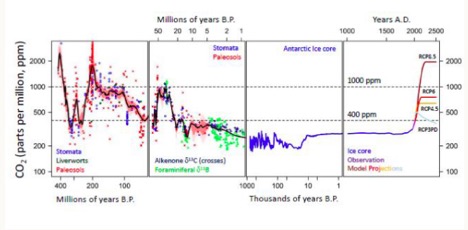
Figure 1: This graph shows atmospheric CO2 levels throught Earth’s past. Here it can be seen that Earth has experienced CO2 levels much greater than 400 ppm. (Jones, 2017).
Yet, within the past few centuries CO2 levels have increased at an unfathomable rate. Before 1750, CO2 levels were at 280ppm and in 2018, according to Mauna Loa Observatory, CO2 levels are currently at 410.31 ppm. Figure two shows that since the 1950s CO2 levels have increased at a rate of 0.7ppm/year, and between 2005 and 2014, it increased by 2.1ppm/year (Yap, 2011), meaning thatCO2 in the atmosphere has increased by 126.58 ppm over just hundreds of years where as in the past it has taken thousands to tens-of thousands of years to increase at the same level. Therefore, it is possible to increase to thousands of parts per million in just hundreds of years at the rate it is currently increasing. Cable and Marvel, well they may have just been onto something.
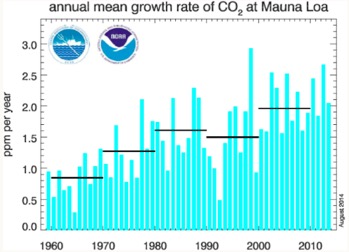
Figure 2: Annual mean growth rates of atmospheric CO2 since 1950 according to Mauna Loa observatory. (Jones, 2017).
So what the HECK does this mean?!?
As you can see, Earth has experienced much higher atmospheric CO2 levels (Figure 1), therefore 400 ppm is not necessarily a “dangerous” level of atmospheric CO2 for the Earth, but could be potentially dangerous for humans. The last time CO2 levels were near this number was about 5.3 to 2.6 million years ago, when CO2 levels were between 300 and 400 ppm. During this time, the global temperature was about 3 °C warmer, sea levels were between 15-25m higher, and the Sahara Desert likely would have been covered in vegetation (Jones, 2017).
According to NASA, 13,500 square miles of sea ice has been lost a year since 1979 (NASA, 2018). And, according to research conducted at Harvard University, 16,000 years ago it took 6,000 years for sea-level to rise 90 meters, rising at a rate of 15mm/year and over the past 1,000 years, rates have been rising at less than 0.1 m/year. (Bauch, H., et al, 2016). Yet, in the past 100 years, human impacts on oceans have resulted in increased rates of sea-level change. Satellite measurements from NASA show that over the past 100 years global sea level has risen from 0.10 m to 0.20m, a 1.6 mm/year increase! Whereas, in the past 20 years, the annual rates have been 3.2 mm/year, twice the rate of the past 80 years (Figures 3 and 4).
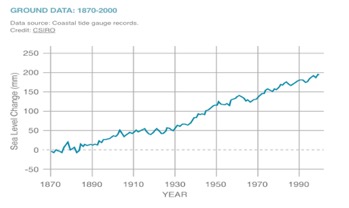
Figure 4: Sea-Level change in millimeters following industrialization. (NASA, 2018).
How does this whole Shmea-Level Sea-Level-Rise Stuff Work, Huh?!?
The Ocean, which acts as a giant carbon sink absorbs the increasing CO2 from the atmosphere, this in return reduces the heat lost by the ocean and makes the ocean warmer. Sea-levels can rise from two primary factors associated with warm oceans, the first being thermal expansion.
Thermal expansion results in the expansion of water because as water heats up it expands; therefore, warmer oceans occupy more space.
The second primary factor causing sea level rise is the melting of glaciers and polar ice caps, and ice loss from Greenland and West Antarctica. Increased heat results in accelerated melting rates. Then the melted warmer water from the top of the ice seeps beneath the sheets. This “loosens” ice streams, causing them to move more quickly into the sea.
Also, higher sea temperatures cause massive ice shelves that extend out from Antarctica to melt from below, weaken, and then break off (Bell, 2000). Due to a buoyancy, as ice enters the oceans, it floats in the water, causing water levels to become higher AND melted ice results in water+water=MORE WATER!!
These processes result in higher rates of coastal erosion. As sea-level rises near coasts, shorelines of coasts erode as they are pushed back. Bye-bye beautiful coastal cities!
Sea-level rise also leads to storm surges. When large storms hit land, higher sea levels mean more water and more energy, resulting in more powerful storms. Also, as sea water enters land it can contaminate the water we drink and our soil as well (Bell, 2000)….yikes!
Well WHY IS THERE STILL SNOW!?!
Warmer oceans mean different weather. Our weather is heavily determined by the different wind systems over ocean currents. With warmer oceans, the melting of ice-caps leads to longer winters in some areas because the cold fronts released from the melted ice, move down over areas causing prolonged winters and even enormous amounts of snow in some areas, even areas that are not used to snow. Areas that don’t receive these cold fronts may experience extreme droughts, many powerful hurricanes from storm surges, and coastal changes.
Okay Coooool, what about that Ocean Acidification Thing?
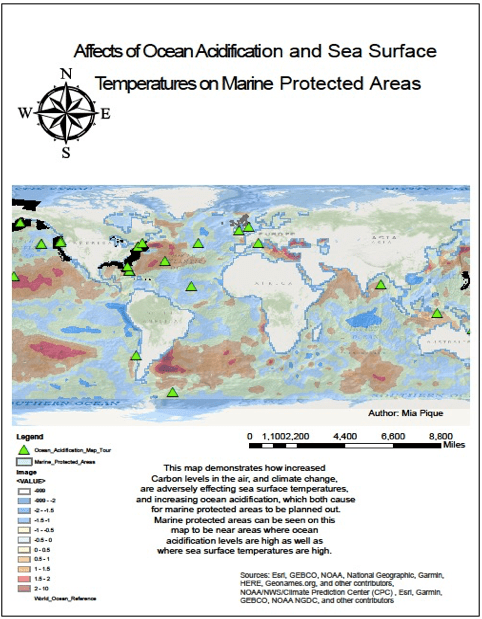
Uptake of CO2 by the oceans lowers pH levels, and increases the concentration of Hydrogen ions. As Hydrogen increases, pH levels decrease. Over the past 20 years, ocean pH levels have dropped from 8.2 to 8.1, dropping by 0.1 pH and becoming more acidic (Yap, 2011). This is causing ocean calcium carbonate to decline, which is what many marine animal’s shells are made out of. This reduction in calcium carbonate has led marine organisms that rely on calcium-carbonate to build their shells, such as corals, to become endangered. This is because their shells are beginning to dissolve as a response to ocean acidification. The endangering of such marine animals has led to the creation of marine-protected areas around the world, where ocean acidification is high in conjunction to warmer ocean waters (Figure 5). Fish that rely on these organisms to eat may begin to die if their food sources are taken away, which means one of our food sources may be taken away from us as well.
I’m on to you…this whole Climate Change Stuff is Pretty Convincing.
Sea-level rising and ocean acidification are only TWO of the many factors influenced by increasing CO2 levels; but, it shows that, yes, the climate is changing, and it really isn’t too entertaining, considering we as humans are destroying our home, Earth. Once it’s destroyed to a certain level, humans won’t be able to live on it…and then Harambe really will never be able to be the U.S. president.
References:
Bauch, H., Abramova, E., Alenius, T., and Saarnisto, M., 2016, Special Paper 443: Response of Upper Gulf Coast Estuaries to Holocene Climate Change and Sea-Level Rise: Postglacial sea-level rise and its impact on the circum-arctic Holocene climate evolution, doi: 10.1130/978-0-8137-2443-0
Bell, R.G., Goring, D.G., and de Lange, W.P., 2000, Sea-Level change and storm surges in the context of climate change: IPENZ Transactions, v. 27, p. 1-10.
Jones, N., 2017,” How the World Passed a Carbon Threshold and Why It Matters”: Yale E360.
Royer, D.L., 2016, Climate Sensitivity in the Geologic Past: Annual Review of Earth and Planetary Sciences, v. 44, p. 277–293, doi: 10.1146/annurev-earth-100815-024150.
NASA Global Climate Change, 2018, NASA, https://climate.nasa.gov/vital-signs/sea-level/ (accessed April 2018).
Yap, H., 2011, Faculty of 1000 evaluation for the growing human footprint on coastal and open-ocean biogeochemistry: F1000 – Post-publication peer review of the biomedical literature, doi: 10.3410

