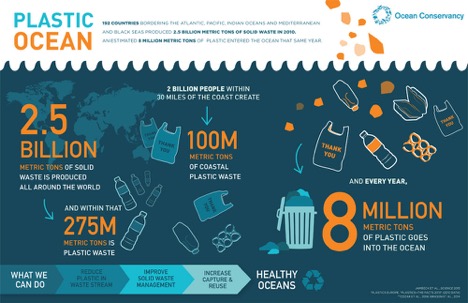
A diagram to put plastic waste to perspective. Sourced from: https://steemit.com/ocean/@sc-steemit/can-we-stop-using-plastics-costa-rica-thinks-so
One may be re-reading that title over and over and thinking…umm what?? But, nope they read it right! Plastic is on the menu for today…and well maybe forever unless some change starts happening. According to Euromonitor International, 480 billion plastic bottles were produced and distributed world-wide in 2016 …and this number is estimated to reach 583.3 billion (Laville, Taylor 2017).
Where is the majority of this plastic going? And, the ideal answer of “It’s being recycled!” is not the correct answer. The majority of this overproduced plastic is being discarded into the Earth’s oceans. A study linking worldwide data on solid waste, population density, and economic statuses that scientists wrote for Science Magazine, showed that nearly eight million metric tons of plastic waste from land, enters the ocean a year (Jambeck 2015). That’s the equivalent to 533,000 school buses, people…533,000!!
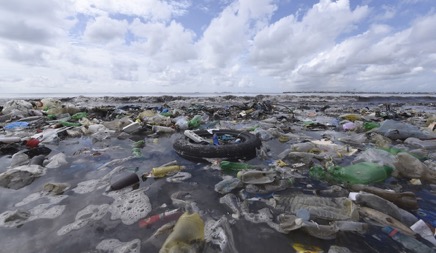
Photograph of trash in the ocean. Sourced from: https://www.theguardian.com/lifeandstyle/2017/feb/14/sea-to-plate-plastic-got-into-fish
Not only is this harmful to animals, but to humans as well. The plastic dumped into the ocean ends up in our food…what a crazy thought! In 2013, the average shell-fish consumer ingested 11,000 pieces of tiny plastic through their seafood… in Europe alone (Rochman 2013). A study conducted just 10 months ago, that tested eight different brands of sea-salt, showed that seven out of eight of the brands tested positive to having micro-plastics in them…meaning that the salt in and on our food, is being ingested daily, and is highly susceptible to having micro-plastics within it (Karami 2017).
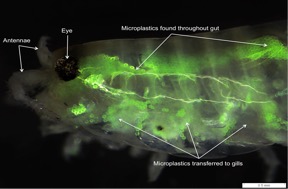
Micro-plastic found inside a fish. Sourced from: https://theconversation.com/how-microplastics-make-their-way-up-the-ocean-food-chain-into-fish-69148
At the rate humans are continuing, by 2050 there will be more plastic than fish in the ocean (MacArthur 2016). The best way to combat the eight million metric tons of plastic being dumped into the ocean a year, is to start by knowing where “recycled plastic” is actually going by checking in with your local laws. Also, to get involved in local politics and to let local representatives know you are serious about the issue…because your representatives work to keep their represented citizens happy! On a smaller scale, you can start by using non-plastic products, such as bringing reusable bags to grocery stores and by using a reusable water bottle!
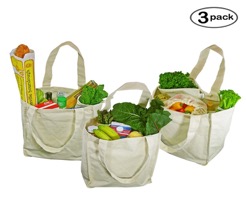
Resuable grocery bags. Sourced from: https://www.amazon.com/Simple-Ecology-Organic-Reusable-Grocery/dp/B004V50P7S
References:
Jambeck, J. R., et al. “Plastic Waste Inputs from Land into the Ocean.” Science, vol. 347, no. 6223, 2015, pp. 768–771., doi:10.1126/science.1260352.
Karami, Ali, et al. “The Presence of Microplastics in Commercial Salts from Different Countries.” Nature News, Nature Publishing Group, 6 Apr. 2017, http://www.nature.com/articles/srep46173.
Laville, Sandra, and Taylor, Matthew. “A Million Bottles a Minute: World’s Plastic Binge ‘as Dangerous as Climate Change’.” The Guardian, Guardian News and Media, 28 June 2017, http://www.theguardian.com/environment/2017/jun/28/a-million-a-minute-worlds-plastic-bottle-binge-as-dangerous-as-climate-change.
MacArthur, Dave Ellen, et al. The New Plastics Economy Rethinking the Future of Plastics. World Economic Forum, 2016, The New Plastics Economy Rethinking the Future of Plastics, www3.weforum.org/docs/WEF_The_New_Plastics_Economy.pdf.
Smillie, Susan. “From Sea to Plate: How Plastic Got into Our Fish.” The Guardian, Guardian News and Media, 14 Feb. 2017, http://www.theguardian.com/lifeandstyle/2017/feb/14/sea-to-plate-plastic-got-into-fish.
Rochman, Chelsea M., et al. “Ingested Plastic Transfers Hazardous Chemicals to Fish and Induces Hepatic Stress.” Scientific Reports, vol. 3, no. 1, 2013, doi:10.1038/srep03263.
sc-steemit, et al. “Can We Stop Using Plastics? Costa Rica Thinks so! SteemCreated with Sketch.” Can We Stop Using Plastics? Costa Rica Thinks so! – Steemit, Sttemit, Sept. 2017, steemit.com/ocean/@sc-steemit/can-we-stop-using-plastics-costa-rica-thinks-so.
 Captured Instances